ISO standards for Personal Protective Equipment (PPE) ensure that protective gear is safe, reliable, and effective in safeguarding workers against various hazards. At SIS we understand that getting the right standard products is extremely important. We have created a guide below to explain the standards on various workwear and PPE.
EU Clothing Standards
RIS-3279-TOM -RIS-3279 is a railway group standard that specifies the minimum specification for high-visibility warning clothing in the UK rail industry ensuring workers are conspicuous when on or near railway lines.
EN 343 - EN343 is the European standard that applies to garments worn in adverse weather conditions. This standard specifies requirements and test methods applicable to the materials and seams of protective clothing against the influence of precipitation e.g. rain, snow and fog.
EN ISO 11612 - Clothing which protects against heat and flame. Users for these garments include those who work in oil & gas, welding & allied processes, mining, petroleum and many other industries.
EN ISO 20471 - ISO 20471:2013 High-Visibility Clothing is an international standard for the safety requirements and test methods of hi-vis workwear, and is applicable to high-risk situations. It specifies requirements for “high visibility clothing which is capable of visually signalling the user's presence”
EN 1149-5 - This European standard is part of a series of standards for test methods and requirements for electrostatic properties of protective clothing. The standard specifies material and design requirements for garments used as part of a total earthed system, to avoid incendiary discharges.
EN ISO 20345 - The current safety footwear standard across Europe is updated in 2011 to make it stricter,
all products must be manufactured, tested and certified under EN ISO 20345. This safety footwear standard requires all safety shoes to have front foot protection against a 200 joule impact.
EN 342 - Ensembles and garments for protection against cold
EN 13034 - Performance requirements for chemical protective clothing offering limited protective performance against liquid chemicals (Type 6 and Type PB [6] equipment)
EN 14126 - Performance requirements and tests methods for protective clothing against infective agents
EN 14605 - Performance requirements for clothing with liquid-tight (Type 3) or spray-tight (Type 4) connections, including items providing protection to parts of the body only (Types PB [3] and PB [4])
EN 61482-2 - Protective clothing against the thermal hazards of an electric arc - Requirements
EN ISO 11611 - For use in welding and allied processes
EN ISO 13688 - Protective Clothing. General Requirements
EN ISO 13982-1 - Performance requirements for chemical protective clothing providing protection to the full body against airborne solid particulates (Type 5)
EN ISO 14116 - Protection against flame — Limited flame spread materials, material assemblies and clothing
EN 1073-2 - Requirements and test methods for non-ventilated protective clothing against particulate radioactive contamination
EU Gloves Standards
EN 374 - Gloves against dangerous chemicals and micro-organisms
EN 388 - Gloves against mechanical risks
EN 407 - Gloves and other hand protective equipments against thermal risks (heat and/or fire)
EN 511 - Gloves against cold
EN 12477 - Gloves for welders
EN ISO 21420 - Protective gloves — General requirements and test methods
EN ISO 16321 - Eye and face protection for occupational use
EU Face, Ears and Head Standards
EN 149 - Filtering half masks to protect against particles
EN 352 - Hearing protectors
EN 397 - Industrial safety helmets
EN 812 - Industrial bump caps
EN 14387 - Respiratory protective devices. Gas filter(s) and combined filter(s)
EN 14404 - Knee protectors for work in the kneeling position
EN ISO 16321 - Eye and face protection for occupational use
EN 166 - EN 166 specifies the minimum requirements for a range of performance tests. This standard contains a set of requirements referred to as ‘basic requirements’, which may be regarded as mandatory.
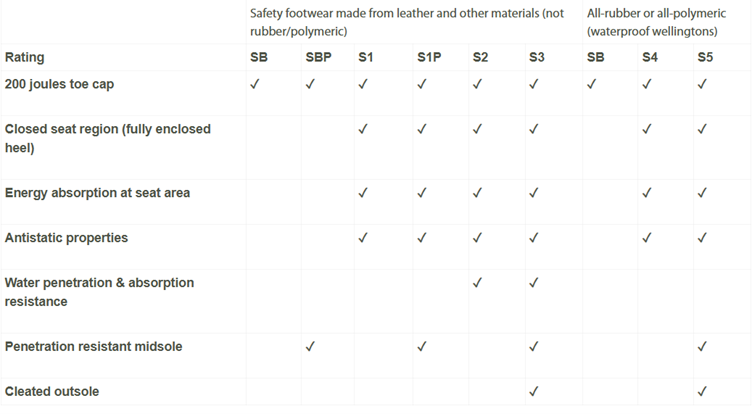
EN ISO 20345 Explained - Safety Footwear Standard
The full name of the EN ISO 20345 specification is EN ISO 20345:2011 Personal Protective Equipment – Safety Footwear which is the standard all styles of “safety footwear” are tested against. The EN ISO 20345:2011 standard sets more stringent minimum requirements than previous versions. It specifies that ALL safety footwear must have toe protection, and sets a standard of 200-joules impact-resistance (equivalent to a 20kg weight dropped 1,020mm onto the toes) and a 15KN compression test (equivalent to 1.5 tonnes resting on the toe area).
EN ISO 20345 Slip Resistance Ratings Explained
SRA: Tested on ceramic tile with sodium lauryl sulphate (a diluted soap solution)
SRB: Tested on steel with glycerol
SRC: Tested under SRA and SRB conditions
EN ISO 20345 Additional Ratings Explained
C - Conductive
A - Antistatic
I - Insulation against electricity
HI - Insulation against heat
CI - Insulation against cold
E - Energy absorbing seat region
AN - Ankle protection
HRO - Heat resistant outsole
WR - Water resistant
WRU - Water resistant upper
M - Metatarsal protection
CR - Cut resistant upper